Procedures After Withdrawal from the U.S.–Japan Status of Forces Agreement (SOFA)
While you are covered by SOFA, you may stay in Japan without being subject to Japan’s residence status system. However, if you retire, your contract ends, or you otherwise lose SOFA status, you will need to obtain a residence status if you wish to remain in Japan for more than 60 days.
The procedures after leaving SOFA status can be difficult to understand, even compared with ordinary visa applications. Many people are unsure which residence status they should apply for, when they should apply, and what documents they need to prepare.
In this article, we explain in a clear and practical way the procedures required after withdrawal from SOFA status, for those who are planning to leave SOFA status or who need to complete immigration procedures after withdrawal.
At our office, we provide support for visa consultations, preparation of application documents, and filing of applications. If you are unsure which residence status may apply to your situation, please feel free to contact us.
1️⃣ What type of application is required?
There are three main types of residence-related applications in Japan:
- Application for Certificate of Eligibility (COE)
→ This is used when a foreign national living outside Japan will newly enter Japan. - Application for Change of Status of Residence
→ This is used when a foreign national who already has a valid residence status in Japan changes to a different status. - Application for Permission to Acquire Status of Residence
→ This is used when a foreign national is already in Japan but does not yet have a residence status under Japan’s immigration system, and needs to newly obtain one.
A person staying in Japan under SOFA is already in Japan, so they are not eligible for an Application for Certificate of Eligibility.
In addition, because they do not currently hold a civilian residence status under Japan’s immigration system, an Application for Change of Status of Residence does not apply either.
Therefore, if you leave SOFA status and wish to continue staying in Japan, you will generally need to file an Application for Permission to Acquire Status of Residence.
This type of application also applies in cases such as:
- A former Japanese national who has renounced Japanese nationality
- A baby of foreign nationality born in Japan
- A foreign national who is staying in Japan without having gone through ordinary landing procedures
If you wish to remain in Japan after leaving SOFA status, it is important to file this application promptly. If the timing is missed, there is a risk of being treated as overstaying.
2️⃣ Deadline and general procedure
As explained above, if you have been staying in Japan under SOFA and wish to remain in Japan after leaving SOFA status, you need to obtain an appropriate residence status through an Application for Permission to Acquire Status of Residence.
The main points are as follows:
- If you will leave Japan within 60 days after withdrawal from SOFA, no application is required
- If you will stay in Japan for more than 60 days, you must file the application within 30 days from the date of withdrawal
- The applicant must be the person concerned, a legal representative if the applicant is a minor, or a certified immigration lawyer / administrative scrivener with authorization to file
- No government application fee is required
Because there is a strict deadline for acquiring residence status after leaving SOFA, it is important to begin the process as early as possible.
The residence status you should apply for depends on your activities in Japan. Common examples include:
- If you wish to work in Japan → a work visa, such as Engineer / Specialist in Humanities / International Services
- If you are married to a Japanese national → Spouse or Child of Japanese National
If you are unsure about the procedures after leaving SOFA status — and wondering, “What should I do next?”
Obtaining a visa after leaving SOFA status involves many important points, including the timing of the application, the choice of residence status, and the required documents.
A visa professional can review your situation and guide you carefully on the most suitable application steps and timing. Why not use our free initial consultation to confirm your options and the preparations you need?
Free Initial Consultation: 1–2 email exchanges | Reply within 1–2 business days
If you are unsure about the procedures after leaving SOFA status — and wondering, “What should I do next?”
Obtaining a visa after leaving SOFA status involves many important points, including the timing of the application, the choice of residence status, and the required documents.
A visa professional can review your situation and guide you carefully on the most suitable application steps and timing. Why not use our free initial consultation to confirm your options and the preparations you need?
Free Initial Consultation: 1–2 email exchanges | Reply within 1–2 business days
3️⃣ Documents that are especially important after leaving SOFA status
For example, if you apply for the residence status Spouse or Child of Japanese National, in addition to the usual application documents, you will also need a document proving that you have withdrawn from SOFA status.
- A document clearly showing that you have left SOFA status
- Notification of Personnel Action
- This is usually issued by your affiliated organization on the date of withdrawal
- After obtaining it, you must file the Application for Permission to Acquire Status of Residence within 30 days
That said, in some cases we have handled, the application was approved without any problem even before the official Notification of Personnel Action was issued, by submitting a document prepared by the affiliated organization certifying the withdrawal from SOFA status.
However, SOFA-related cases are often processed relatively quickly. Therefore, unless there is a particular reason to rush, it is usually smoother to apply after receiving the formal notification.
Lastly — For those who will soon leave SOFA status, or who have already left it
If you wish to remain in Japan after leaving SOFA status, you may be wondering:
“What residence status applies to me?”
“What procedure do I need to follow?”
In situations like the following, it is reassuring to seek advice early:
✅ You want to know which residence status may apply to your case
✅ You want to confirm the required documents and overall procedure
✅ You want to reduce uncertainty about the process as much as possible
If any of these apply to you, please feel free to contact us using the link below.
Based on your circumstances, we will carefully explain your prospects for approval and the steps you need to take.
If you wish, you can also ask us to handle the application on your behalf after the consultation. By organizing the key issues and necessary documents in advance, the preparation process becomes easier and less burdensome.
If you are unsure, please feel free to contact us first.
Free Initial Consultation: 1–2 email exchanges | Reply within 1–2 business days
Selected Articles on the Basics and Procedures of Visa Applications (in Japanese)
ビザ申請に関する手続(6)資格外活動許可申請
資格外活動許可申請とは何か、どのような場合に必要か、週28時間ルール、申請手続、注意点までをわかりやすく解説します。留学生・家族滞在ビザでアルバイトを考えている方はご確認ください。
ビザ申請に関する手続(2)在留資格変更許可申請
在留資格変更許可申請とは、現在のビザでは認められていない活動を希望する外国人の方が、適切な在留資格へ切り替えるための手続です。このページでは、申請の概要や対象となるケース、注意点をわかりやすく解説します。
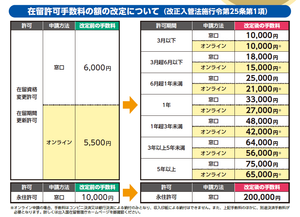
2026年10月ビザ手数料値上げ
2026年10月1日から在留資格変更・更新・永住許可の手数料が大幅値上げ。1年は窓口33,000円、3年64,000円、5年75,000円、永住は200,000円。9月30日までの申請が旧料金になる条件、オンライン申請との差額・納付方法、申請時期の注意点を解説します。